Showing posts with label science fiction. Show all posts

Saturday, May 28, 2011

Review: Revelation Space by Alastair Reynolds

2001, Gollancz Books. 480 pages.
Writing rule of thumb: Don’t parcel out your good ideas, saving them for the sequel. It takes more than one to make a good book.

Alastair Reynolds must have listened, because his novel, Revelation Space, is packed with great ideas.

When a 26th-century dig turns up clues about a dead alien civilization on a distant world, archeologist Dan Sylveste will stop at nothing to discover who -- or what -- caused “The Event” that wiped them out. But as determined as Sylveste is to find answers to the mystery of the extinct Amarantin, others are just as determined to find him. Among them, the crew of the city-sized interstellar ship, Nostalgia for Infinity, who need Sylveste to cure their captain of the nano-plague which is slowly consuming both him and their ship. And among them -- assassin Ana Khouri, contracted by the mysterious Madamoiselle, who has her own interest in Sylveste – namely seeing him dead.

Across multiple worlds and decades, these factions pursue their own ends only to find themselves mere pawns in a millennias-old struggle between ancient intellegences. And of course, this is a struggle that will determine the survival of life in the galaxy.

Friday, May 6, 2011

Movie Review: Heavy Metal 2000

A few years ago, after getting back from Taco Bell, nachos in my hands, a former boyfriend decided to expose me to Heavy Metal the movie. I was stunned after watching it – not in a bad way, but just how different a movie it was (oh yeah, and all those inflated boobs). The gist of it is a collection of fantasy and science fiction short stories tied together by the mysterious Loc-Nar.

Reminiscing, I figured I’d check out the “sequel” Heavy Metal 2000, released in 2000. People gave it a bad rap, but honestly, it’s not as bad as I thought. It’s definitely a homage piece to the original Heavy Metal, taking some of the best parts and stringing them together in a coherent plot (which the original lacked). The story starts when a miner named Tyler (who faintly resembles Sternn) stumbles upon the ‘the key’, which is essentially the Loc-Nar incarnate. The key will open the fountain of youth on another world – the drawback – whoever holds the key will become insane. And in his insanity, Tyler manages to take over the mining crew ship and steer it towards his goal. But on the way, he pillages a village and kidnaps a girl. Problem: the girl has a sister, Julie, and Julie is pissed.     

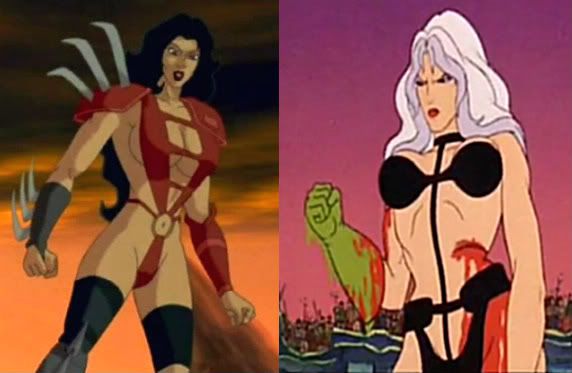
Julie is the black-haired version of Taarna – except she talks, and boy does she have a personality. Julie is just another bitchy kick-ass gal, because God forbid there should be a nice heroine that can also kick-ass. Whereas Taarna’s silent treatment worked to her advantage, and I never disliked her or what came out of her mouth.
(left) Julie from 2000, (right) Taarna from original Heavy Meatal
 The animation itself is also a drawback, as it looks like a Saturday morning cartoon on Fox. The original had a very mature appearance about it and didn’t resemble anything that kids watched back then. Also, the original was beautifully bright, whereas 2000, all colors are subdued (I actually had to brighten Julie’s pic because it was SO dark).

There is violence, lots of it. Guy gets a bullet through his head, brain splatter, guts hanging out. The sex, however, is pretty tame, mostly breast fondling, which causes it to feel like a kiddie movie that has been upgraded to adult status, rather than a movie made for adults.

The CGI blended in worked for the most part, although there were a few spots where it stuck out like a sore thumb. I did enjoy the scenes with spaceships coasting through metaspace, very lovely.

The music, a trademark of Heavy Metal, was rather bland and didn’t put oomph into the scenes. But then again, I prefer music from the 70’s, 80’s, so nothing in this movie connected to me like how it did in the original.

I suppose in the end, nothing can compare to the original, it was groundbreaking at the time of its release in 1981. However, 2000 movie isn’t horrible. The plot is decent (despite the inconsistencies), and the action pretty cool. Although I recommend seeing the original first before this.

Rating: 3 out of 5 stars.    

Wednesday, May 4, 2011

Review: Old Man's War, by John Scalzi

Voted #1 on Tor's Best SFF Novels of the Decade poll. I had heard of it before, but when I was looking for books to catch me up with what's been going on in science fiction (I've been reading a lot of nonfiction) this became my shopping list.

It was a lighter and faster read than I expected. Quickly digestible. It doesn't skimp on the violent details, but I wouldn't call it gruesome. I also wouldn't call it hard SF, but it's not excessively soft either. Good balance, in other words.

From a writerly perspective, war from the standpoint of one grunt on the ground is difficult. It has to be a character-driven story, since as far as action goes the goals are simple and well defined and consistent across all war stories: survive and/or win. Here, the war is really just a distraction from the goal that even our first-person narrator isn't entirely aware he has until the third act. Nicely done.

I've read a little military SF, and I'm glad that this did not fall into the trope of the hero being the best soldier ever, suffering through the inadequacies of his comrades. It's also not married to imitating Napoleonic naval warfare, World War II  or any other era. The world building is substantial (since there are many and varied worlds) and impressive for a relatively short book.

I'm interested to see what he does with this universe in the rest of the series, and I hope to be reviewing them here too.

4 out of 5 weeblies

Tuesday, May 3, 2011

You need to read SFF in order to write it

I see this happen all the time on forums where people share their work. Newbie writer gets a cool SFF idea and writes it out, then posts it. Turns out their idea has not only been done before, but they offer no new angle, and pretty much reinvent the wheel, so to speak. The wheels have already been invented by past generation of SFF writers; they established the tropes that many readers have come to know and love (or hate), thus paving the way for newer writers to focus on other aspects of SFF storytelling.  

Why not take advantage of that? Why unwittingly write something that sounds like it came from a 1970’s SFF magazine?

Tropes of classic SF
In order to move forward, you have to reach into the past and learn from those authors, both their successes and their follies. Absorb it and come up with something better or different than what they wrote. By not reading the classics (Herbert, Asimov, LeGuin – just to name a few authors), you’re doing yourself a disservice, having to build up from ground zero when you could have easily used some well-known tropes. And no, it doesn’t make you a “cookie-cutter” to use old tropes. The key is to be aware that you’re using them, thus giving you an edge on how to subvert them and make them your own.

A good place to start for potential SF writers is watching the original Star Trek, as it has a butt-load of SF tropes embedded in the scripts. Sorry fantasy writers, not sure where you may start – perhaps Tolkien or mythological stories, mostly based on Greek or Western European culture. I’m sure one my fantasy-savvy co-bloggers could fill the readers in. 

Some tropes can be very sexy

Friday, April 22, 2011

Dysto-mayto, Uto-mahto

In fiction, dystopias come in lots of shades.

There’s the oppressive gloom of social and governmental dystopias like V for Vendetta and Minority Report. The bleakness of ecological and environmentally skewed stories in the vein of Waterworld and Soylent Green. The menacing darkness of tech-induced hells such as The Matrix and The Terminator.

Mega-corporations. The post-apocalypse. Zombies.

But as varied (and as good) as these are, their premises are just dismal points plotted along the same grayscale continuum. The despair is widespread, the oppression equal opportunity.

How do you like your steak? Charred, burned, or just overcooked?

 
Many dystopic settings are points along the same grayscale contiuum.
But some of my favorite takes on dystopian futures come in vibrant colors. They have blue skies and fresh air. The food is good, and the tech is great.

Or if not - even if life never strays from beneath the dome of a city - at least the people are happy.


Wednesday, April 20, 2011

Can dystopias be beat?


Reading Teresa Jusino article on dystopias and the new brand of dystopia coming out, which prompted some thoughts of my own since I believe the dystopia-genre was created with a certain message in mind, and thus the unhappy endings.

Looking at dystopias from a psychological approach, since they are very much psychological as they are sociological studies, one has to keep in mind that humans evolved to cohere to their group. Why? Because being left out of the group meant death. Humans need other humans, not just for basic needs, but also for emotional support; being around those you care also lowers cortisol levels, a side effect of stress, which prolongs your life.  So what happens when the entire group follows an authoritarian government? Well the individual follows along as well, even if they know it’s not right. Social psychology experiments such as Milgram’s  and Zimbardo’s Stanford prison have shown that people, just like you and me, will follow authority figures even though that means conducting in unethical acts. We don’t want to be left out, simple as that. This also leads to social effects such as diffusion of responsibility, where it’s not our personal problem to confront Big Brother, and that surely someone else will do it. Except everyone else is thinking the same.

And in a world where everything is controlled by the government, it’s easy to imagine the people learn to become helpless. Because what’s the point? All you can do is breath, eat, and sleep.

There are rare cases where an individual will stand up, even at the cost of being ostracized by their group. But such cases like Martin Luther King Jr. and Gandhi have shown they face hostile reaction from their peers and eventual assassination. And that is the sad truth, sometimes it doesn’t pay to be a hero.

So can dystopias be beat? It’s a possibility, but it’s one that requires a lot of sacrifice from individuals, one that most of us are not willing to give (notice how people still drive around in their SUVs despite the rising gas prices). This is why heroes are so rare and revered, both in fiction and reality, because they did something that most of us can’t.

And I know it sounds very depressing, which is the point of dystopias, not to cheer you up but to kick you into gear. Don’t depend on a hero to come along when you yourself are capable of being active in your own government. Better to be mindful of what your government is becoming and halt its progress (i.e. don’t vote for bad politicians)  than to have to go through a bloody revolution to reverse its effects, which not only means fighting Big Brother, but also fighting people just like yourself who can’t quite see the truth.

Don’t beat a dystopia – prevent it!

Wednesday, April 13, 2011

Round Robin - Dystopia: Unhappily Ever After

Dystopias are quite fascinating ‘what ifs’. What if the government became a tyrant? What if all our rights and freedoms were taken away? What if our lives were completely disposable? It gets pretty scary, like a horror movie on a sociological scale. And that’s what I believe dystopias were originally meant to achieve: to scare the hell out of you with terrifying Big Brother societies that could toss you around like their personal play thing. Your life meant nothing. You meant nothing.

But why all the unhappiness? Can’t we have a glimmer of hope that the hero may make? Sure, but it’s going to be a false hope. The idea of dystopias was a warning, that this was the sort of society you didn’t want and for good reasons too. George Orwell’s 1984 dystopian society was brutal fascism, where propaganda was pounded into your head and Big Brother invaded your privacy. You learned to believe in contradictions and to always trust the government’s decision. If Big Brother said ‘jump’, you would ask ‘how high?’ And in the end you couldn’t win. Oh, the hero (Winston Smith) does try, but ultimately he is broken and re-educated. It’s unhappy and it’s meant to be.    

A happy ending would only offset the warning that Orwell was trying to show. Imagine if the Surgeon General’s warning ended on a light note: Smoking Causes Lung Cancer, Heart Disease, Emphysema – oh but with modern medicine, you have a fair chance of surviving just about anything. Doesn’t quite have the same impact.

And think about it, if it were really that easy for the protagonist to escape or fix society, wouldn’t it have been done long ago? It takes a lot for society to change, massive movements and sometimes bloody revolutions. And if the government has an iron grip over the citizens, chances are any change has to occur underground, which really hinders it. Escaping may not be so great either as most folks don’t know how to survive on their own, and unfortunately, society has done nothing to prepare people – hell, they can’t even prepare kids who are entering the real world. And then there are surviving the elements, disease, and predators. After a while, Big Brother might not be so bad. 

The best way to stop a dystopian society is to prevent it from ever happening, because once it’s set up, you going to have a helluva time trying to get away. And although dystopias may be speculative fiction, there’s always a shred of truth to them, art imitating life. So be mindful, because Big Brother hasn’t stopped watching you. 

Monday, April 11, 2011

Round Robin Conversation #1 - Dystopia

Let's start with dystopia.

There was a fairly recent blog post about dystopia (at Literary Friction) which got me interested in how it's being defined currently. Why currently? Because the current definition's a little different from the one I remember.

I grew up in the later stages of the Cold War (in the US) and we had our prime example of dystopia right over there in the USSR: paranoia, surveillance, people disappearing, fear and violence, all under the pretense of being a "worker's paradise." Sure, there were a few people accusing our government of the same, but we were obviously nothing like the Soviets. Maybe there was some concern that we were heading toward a better-living-through-pharmacology dystopia as seen in Brave New World and THX 1138, but at least we weren't heading for a violent, fascist state like 1984.

Then the Berlin Wall fell, the internet brought the world to our desktops, 9/11 blindsided us and it's ten years of war and counting.

What does dystopia look like now? What does it look like in urban fantasy, high fantasy, horror? I think this is a great place to start a conversation among the six of us. We'll be blogging our thoughts and letting the conversation stray where it wills (which is what's so great about conversations after all) as long as we keep it relevant to our genres and/or creative writing.

Thursday, March 31, 2011

8 Opening Lines From The Greats of Sci Fi

Countless hours of creative agony. A months-long artistic marathon full of toil and loneliness. 350 pages of blood, sweat, and tears.

And here I am, about to package it all up as a tidy email attachment. As I prepare to push Send, hoping to catch the fleeting and jaded attention of a that one agent or editor who’ll smile on my work and help usher me into the hallowed Order of The Published, I find myself taking a second look at what they’ll see first.  Five words out of a hundred and five thousand.  

My opening line.

The Opening Line
Everyone will tell you the opening chapter of any book is important. Your first page is even more important, and your first paragraph more important still.  

Your opening line? Well, you get the idea. It’s that first lonely spark that either gets the fire going, or sputters and dies in darkness.

Then I wondered – how might I stack up against the openers from the best-selling classics we know and love? That’s something I can’t answer yet (or maybe I just don't want to), but I thought it might be fun to go through a few and see how well they do the job.  So here they are – the inaugural words from some of the heavyweights of science fiction:

Wednesday, March 30, 2011

Review - Hunter's Run by George R.R. Martin, Gardner Dozois, and Daniel Abraham


There are a number of interesting things going on in this story. I'll try to explain without causing any spoilers.

1. Our hero is a jerk.
2. Interesting, sympathetic aliens who are neither cute nor cuddly.
3. Human civilization in the background is Hispanic/South American, not your standard issue white bread.
4. Interesting identity bending.

Suffice it to say that #2-4 managed to keep me reading in spite of #1.

From a writer's point of view, this story is all about carefully choosing what to explain to the reader, and when to explain it, and how to do it without bogging down the hunting aspect of the plot that's keeping the whole thing moving. At the same time, the hero is coming to grips with things that he never expected to. Can't say much more without spoiling it for you, though.

The ending was a little... soft, in my opinion, but I'm not complaining too much. Still recommending it.

Retro tie-in: The hunting aspect made me fondly remember two anthologies I read many years ago. They probably qualify as "vintage" SF if not "classic" by now... Men Hunting Things and Things Hunting Men. Pulpy, fun, old-school SF.

Friday, March 25, 2011

Book review: Song of Scarabaeus

In anticipation for Sara Creasy's sequel, which comes out March. 29, I thought I'd post this review of her awesome debut novel Song of Scarabaeus.

The gist: Edie is a biocyph, a combination of biology and cybernetics that's necessary to germinate new worlds. While on the job, she's kidnapped by space-pirates and forced to work for them. Their goal: to free the Fringe colonists from the repressive Crib government that holds a monopoly over everyone's heads. And it's not just her life on the line. The pirates link her up to a former slave, now her bodyguard, and if she tries to run, her bodyguard will die.


Pros: Now I like Edie, except for her stupid moments at the end when she tries to save everybody - sorry, but you're not superwoman. She's neither a kick-ass female nor a weak vulnerable girl; she has her strengths and weaknesses and has some really cool abilities, like being able to manipulate DNA on a cybernetic level. She is slightly passive, but considering her circumstances it's not like she could do much. She did attempt to break free and to me that says something even if she wasn't successful. I also like the allusions to music in the tech scripts, how the scripts sang their songs. That was cool.


I love the science in the book it gets into a technical level, but if you've taken a biology course it shouldn't be too hard to get. It's what makes science fiction science fiction after all. The romance is brief, but for me, I was glad it didn't derail the main plot. I honestly hate it when the romance between characters overwhelms the main point of the book.

Negs: I had my eyes rolling when some of the crew, who were originally sticking guns into Edie's side, suddenly try to be her best pals. I felt like Edie forgave them too easily just because they put a smile on. There's also a false choice at the start, where they say she can go with them or stay working for the Crib, which made no sense. Why go through the trouble of kidnapping her only to give her a choice? Plus, it was clear they were never going to let her go. Kill her, sure. But not set her free.

I also didn't care for Edie's dreams, partly because they're in present tense, and partly because they read like a prologue, except they're spread throughout the book rather than dumping it in front. I guess it's a clever way to get people to read prologues. I know the dreams are suppose to add context to Edie, but I always feel how the main character behaves in their current situation will reveal more about them than giving us a history lesson on the character. Plus, who has dreams of their past? These aren't exactly flashbacks.

Then there's Haller. I hated him so much. But not because he's the antagonist, but because he's so stupid and 2-dimensional. I honestly cannot picture a whole crew following his short-sighted plans. He constantly lets his anger get the better of him, which makes him a bad leader with very little respect. If there was some redeeming quality, I could see why they may follow him, like perhaps he's a jerk but he has brilliant strategies. Instead, he was just a doofus who demanded that everyone else to fix his problems. Luckily, he won't be coming back for the sequel.


Overall, I give this book 4 out of 5 stars. It has its flaws, but still enjoyable to read if you're looking for a space adventure with a touch of romance.

This review was originally posted on Amazon under my account.

Thursday, March 24, 2011

Review - Eon, by Greg Bear

Nothing ages faster than the future.

Eon, by Greg Bear, was published in 1985. It was set in 2005. And even though the fall of the Berlin Wall was less than five years away when this was published, there was no doubt in the author's mind that the Cold War would continue into the new millennium. That was the first thing that made me pensive.

The other thing that struck me was how easy it was to fall back into the Cold War mentality (like riding a bike?). Which is why I don't blame Mr. Bear for the first point -- I remember how sudden, how stunning, it was to watch the Soviet bloc unravel.

Anybody here too young to remember that? Thoughts on reading Cold War-era science fiction?

Getting back to the book: despite the dated Cold War assumptions, the book holds up. The names and governments may have changed, but if a mysterious, self-propelled asteroid appeared in near Earth orbit I expect things would still play out along similar lines today. As a hard science fiction fan I was especially interested in the invasion of an O'Neill habitat from its zero-gee axis. Once the story moved into more advanced levels of sci-fi, the "hardness" becomes less relevant but where it was still obvious, the laws of physics held firm.

From a more structural point of view, this is a book with many subplots. Most of them overshadow, in fact, the one plot that runs through the entire novel -- Patricia wants to go home. The throughline persists just visibly enough that when it asserts itself toward the end, you see that it was the goal all along. An interesting lesson in structure.

One last point: at first blush, this novel made me think of Rendezvous with Rama, by Arthur C. Clarke. All they have in common is the O'Neill habitat, though. If you're interested in hard science fiction, you should read both.

Saturday, March 19, 2011

Review - Battle: Los Angeles

A veteran unit of marines goes into battle against an unknown foe, led by a grizzled sergeant and a freshly-minted rookie lieutenant. From the petrified private, to the shell-shocked corporal, to the tough-as-nails air force sergeant, the characters find themselves in heavy combat, fighting for their lives. As the casualties mount, the reluctant Sgt. Nantz steps up to lead the squad from harm's way, protect a handful of civilians, and find a way to defeat the enemy -- all while facing the inner demons of his own past.

Oh. And there are aliens.

Thursday, March 17, 2011

Just Dream

Gonna do something different because, you know, I gotta be different. I'm not a fan of talking about myself, but I do like to share things, and I want to share an awesome Toonami promo - if you don't know what Toonami is then you missed out. It was a collection of actiony cartoons (mostly animes) on Cartoon Network, and I'd rush home every weekday after school to catch it. Yes, that's right, once upon a time Cartoon Network was actually something watchable. I told you you missed out.

In regards to the toonami promo, it spells out how I feel about sci-fi/fantasy genre. It’s the inspiration that makes us go out and pursue what we do, to create what we create, to turn the imaginary into reality. Like looking up at the night sky and thinking: “I’m totally going to get my ass to Mars.”

And it’s flat out friggin awesome what people can do when inspired by sci-fi/fantasy, like create real lightsabers – okay, so it’s not quite the same, but you can pretend! Hopefully one day we will get to Mars or maybe one of the moons Jupiter and explore another world, besides the ones in our heads. But until then we have to keep dreaming, and even if we don’t make it, those dreams will be left behind for others to pick up and carry on. We’ll make it, in some shape or form, humans may be stupid at times but we’ve got perseverance, like a cockroach – just not as crunchy.

So keep on dreaming, who knows what it might turn into tomorrow.

Tuesday, March 15, 2011

Burned on the brain

2010: The Year We Make Contact

If you hear about this movie at all, it's usually in the context of how it wasn't as good as 2001. When I saw it, I didn't know that it was a sequel and somehow, in spite of having already seen Star Wars and Star Trek and Tron and the original Battlestar Galactica and many episodes of Tom Baker-era Dr. Who that gave me nightmares, it was 2010 that crushed all the space opera under a perfectly proportioned black monolith and made me a hard science fiction writer.

There's a moment in the movie where the Leonov is approaching Jupiter and the frame is simply the planet, black space, and the ship with its center portion spinning... it's burned on my brain. When I started writing science fiction, there was nowhere else for me to go. Back to Jupiter.

All the science fiction I've read or seen since then has covered all the great themes of the genre: action, adventure, fear, idealism, oppression. I've always been fond of the wonder, though. The cosmic grandeur. Sure, I've made my pilgrimage to Mordor, I've languished in Narnia and Earthsea. Fantasy has its grand themes of good and evil. But space is different.

A planet, a ship and the void. Let's go.

Creating the Story

So we’re kicking things off here at WU with an exciting stable of contributors who’ll each focus on sci-fi, fantasy, or horror from the writer’s perspective. To get things started, we’re taking a peek at what gives us a passion for these mainstays of speculative fiction and what drives us to write stories in them.

For me, this could mean a look back many things. How the unreal became so real the night I first saw Star Wars in theaters at the ripe old age of four. Or how I couldn’t wait to get home from school each day to turn on the TV and be transported to Iscandar in Star Blazers or see the Fiery Phoenix in Battle of the Planets. How I’d shamelessly sink every quarter I could beg, borrow or steal into the slots of video games like Space Invaders, Asteroids, and Galaga.

So many quarters gone...
Movies, cartoons, games – when it came to science fiction, I consumed it all, condensing it down to a sugary pulp of imagination like cotton candy.

But it wasn’t until I got my hands on an unremarkable little paperback from my school library that I learned there could be more to it than just consuming these stories, these other worlds. That I might be able to create them myself...